Intersections & Roundabouts
Intersections are some of the most important places to slow down, look carefully, and make good decisions. Whether you're approaching a stop sign, traffic signal, four-way stop, or roundabout, the goal is the same: know where you are going, know who has the right-of-way, and don't rush.
Steer Clear Tip:
Don't memorize intersections — learn to read them.
Every intersection may look slightly different. Signs, signals, lane markings, traffic patterns, pedestrians, and other vehicles can change what you will need to do.
A safe driver looks ahead, recognizes the information available, makes a plan, and then drives through the intersection deliberately.
Before You Enter an Intersection
Start making your decisions before you reach the intersection.
Look for:
Stop signs, yield signs, and traffic signals
Lane arrows and pavement markings
Crosswalks and pedestrians
Vehicles approaching from other directions
Your intended lane after the intersection
Traffic that may be turning across your path
Vehicles behind you who may not slow enough
Choose your lane early. Don't wait until you're in the middle of an intersection to decide where you need to go.
Four-Way Stops
At a four-way stop, every vehicle must stop.
After stopping:
The first vehicle to arrive generally proceeds first.
If vehicles arrive at approximately the same time, the vehicle on the right generally proceeds first.
If two vehicles are facing each other and one is turning left while the other is going straight, the vehicle going straight generally proceeds first.
When in doubt, communicate clearly and proceed cautiously.
Remember: A four-way stop is not a race.
Roundabouts
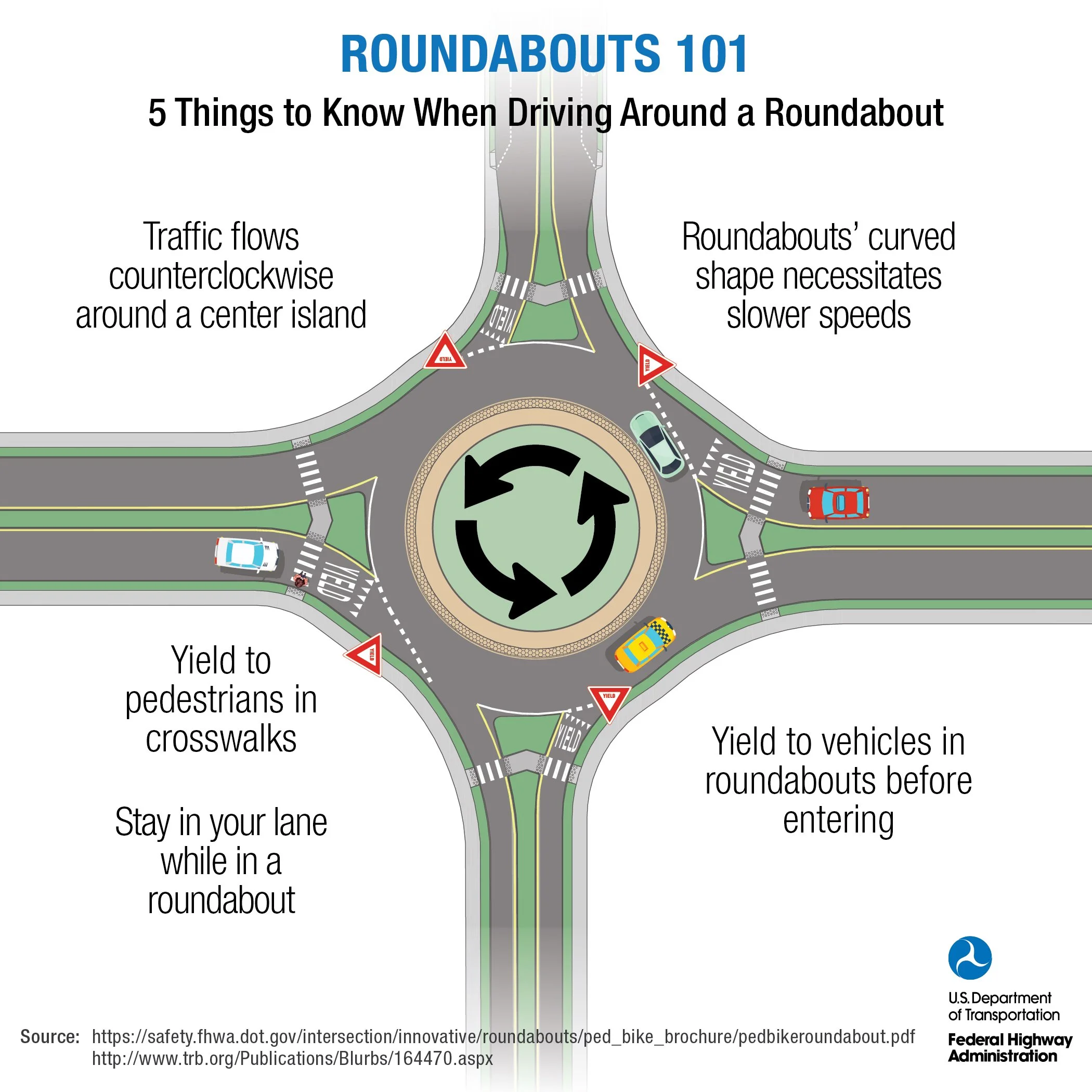
Roundabouts can seem confusing at first because traffic is continuously moving around the circle. The basic idea is simple:
Slow down → Yield → Enter when clear → Stay in your lane → Signal to exit
Entering a Roundabout
Before entering:
Be in the proper lane prior to entering
Slow down.
Look to your left for traffic already in the roundabout.
Yield to traffic that has the right-of-way.
Enter only when there is a safe opening.
Continue around the center island in a counter-clockwise direction
Do not stop inside the roundabout unless traffic conditions require you to.
Choosing Your Exit
Think about your destination before entering.
First exit: generally a right turn
Straight through: continue around to the appropriate exit
Later exit: continue around the roundabout until you reach it
At a multi-lane roundabout, follow the lane markings and signs. Do not change lanes inside the roundabout.
Exiting
As you approach your exit:
Check for pedestrians.
Signal your exit when appropriate.
Move smoothly toward the exit.
Watch for vehicles beside you.
Right-of-Way: Don't Assume — Look
Right-of-way rules help determine who should proceed first, but having the right-of-way does not mean you should force your way through an unsafe situation.
Remember: whoever has the last clear chance to avoid a collision MUST take some measure (steering, braking, or a combination) to prevent the crash.
At an intersection:
Obey all signs, signals, and pavement markings.
Come to a complete stop when required.
Yield when required.
Watch for pedestrians and other road users.
If another driver does something unexpected, slow down and avoid the collision rather than trying to prove you were right.
Turning at Intersections
For a right turn:
> Signal early.
> Check for pedestrians and bicyclists.
> Stay in the appropriate lane.
> Complete the turn into the proper lane.
For a left turn:
> Signal early.
> Position correctly.
> Look for oncoming traffic, pedestrians, and other hazards.
> Do not “claim the intersection”.
> Finish in the appropriate lane.
One of the Most Common Beginner Mistakes
Looking only in the direction you want to go.
When turning left, for example, a driver may become focused on making the turn and fail to continue checking for pedestrians, vehicles, or changing traffic conditions.
Keep scanning throughout the entire maneuver.
Common Mistakes at Intersections
1. Rolling through a stop sign
A slow roll is not the same as a complete stop.
2. Looking too late
Don't wait until you're at the intersection to start looking for signs, lane markings, or traffic.
3. Turning into the wrong lane
Know where you need to finish the turn before you begin it.
4. Assuming someone else will yield
Never base your safety on another driver's decision.
5. Stopping unnecessarily in a roundabout
If you have entered and your path is clear, keep moving.
6. Changing lanes at the wrong time
Plan your lane position before entering whenever possible.
7. Focusing only on the vehicle ahead
Intersections require you to scan the entire area, including sidewalks and crosswalks.
8. Entering the intersection when you cannot clear it in one move
Getting stuck in the intersection when the light turns red and blocking traffic causes grid-lock
Tennessee Driver Resources
For the complete Tennessee rules and requirements, refer to the official Tennessee Comprehensive Driver License Manual.
This Learning Center is intended as a supplemental educational resource. It does not replace the Tennessee Comprehensive Driver License Manual, Tennessee law, or instruction provided by a qualified driver education instructor.
Want to See It?
This video provides a visual explanation of right-of-way situations including uncontrolled intersections, T-intersections, opposing stop signs, four-way stops, yield signs, and roundabouts:
Learn to Drive, Determine the Right-of-Way & Give Way to Road Users — Smart Drive Test
For a more focused visual explanation of roundabouts, this video demonstrates entering, lane positioning, turning, and exiting:
Roundabouts Explained: Who Has the Right of Way? — Zutobi Drivers Ed
Ready to become a safer, more confident driver?
Steer Clear Driver's Ed provides comprehensive driver education for new drivers throughout the Kingsport and surrounding East Tennessee area.